
Guide to Fixed Asset Management for NZ Businesses
You’ve probably felt this before. The vans are on the road, the tools are spread across jobs, the office fit-out was done years ago, and there’s a rough idea of what everything cost. But if someone asked what’s still on hand, what’s financed, what’s due for replacement, or whether the depreciation in Xero matches reality, the answer would be less certain.
That’s where fixed asset management stops being an accounting tidy-up and starts becoming a business tool. If you own vehicles, machinery, workshop gear, IT equipment, or property-related fit-outs, your register affects tax, cash flow, pricing, lending conversations, and replacement planning.
Your Guide to Fixed Asset Management
An Auckland trade business can build up assets gradually. One ute becomes three. A few ladders turn into a storeroom full of gear. A workshop gets fitted out. A compressor is replaced. A trailer is sold. After a few years, the accounts file says one thing and the yard says another.

That’s common. Approximately 68% of small and medium-sized enterprises in New Zealand reported that they do not maintain a formal, centralized fixed asset register according to the New Zealand Treasury’s 2021 Business Survey on Asset Management. The practical result is messy numbers, missed deductions, and balance sheets that don’t reflect what the business owns.
What fixed asset management really means
At ground level, fixed asset management is knowing:
- What you own
- What it cost
- Where it is
- How it’s being depreciated
- When it needs replacing
- Whether it still exists
A register isn’t there to satisfy a spreadsheet. It’s there to stop you making decisions off bad numbers.
This also matters when assets reach end of life. If you’re disposing of old computers, phones, or servers, data security and proper disposal matter just as much as the accounting entry. For businesses dealing with retired tech, Reworx Recycling ITAD solutions are a useful example of how the physical disposal side should line up with your register.
Why Good Asset Management Matters More Than You Think
The biggest cost of poor fixed asset management usually isn’t the tax risk. It’s that owners rely on numbers that aren’t telling the truth.
A construction client had built up tools, small plant, and vehicles over time. The register hadn’t been reviewed in years. When the clean-up started, several assets were still on the books even though they’d been scrapped or sold. Some newer purchases weren’t in the register at all. A few older items were fully depreciated but still being used every day.

What changed after a register clean-up
Once the register was reset properly, the business could:
- Write off obsolete assets and claim the related tax deduction
- Add missing purchases so the balance sheet reflected current operations
- Match finance correctly to the assets it related to
- See replacement pressure coming instead of getting surprised later
The tax benefit mattered. The stronger balance sheet also mattered when talking to the bank. But the primary shift was operational. The owner could finally see the true cost of keeping the business running and started factoring realistic replacement costs into job pricing.
Practical rule: If an asset register is wrong, your profit can look better or worse than it really is. Either way, it pushes owners towards poor decisions.
What doesn’t work
A lot of businesses fail here for simple reasons:
- Too much detail too early. If the system is fussy, nobody keeps it current.
- Blind trust in software. Xero only knows what someone entered.
- No physical check. An asset can stay in the file long after it’s gone from site.
The useful approach is plain and repeatable. Check what exists. Remove what’s gone. Add what’s missing. Then review future replacements before cash gets tight.
How to Set Up a Practical Fixed Asset Register
A good register should help answer ordinary business questions without a hunt through old invoices. What do we own, where is it, what did it really cost, and what is likely to need replacing next? If the register cannot do that, it is only half useful.
For most Auckland SMEs, the practical test is simple. Can someone update it after a purchase, check it at quarter-end, and trust it when making spending decisions?
The fields that matter
| Field | What to Include |
|---|---|
| Asset description | Clear name such as Toyota Hiace van, workshop fit-out, heat pump, laptop |
| Purchase date | The date the asset was bought |
| Cost | Purchase price plus directly attributable costs |
| Useful life | Expected period of use |
| Depreciation method and rate | IRD rate where appropriate, or straight-line for internal reporting |
| Accumulated depreciation | Total depreciation recorded to date |
| Book value | Cost less accumulated depreciation |
| Location or job allocation | Site, branch, vehicle, property, or project allocation |
| Notes | Finance attached, disposed, replaced, written off, repair history |
Keep the cost field honest
The cost field is where plenty of registers go wrong. It is not always just the supplier invoice.
If a workshop buys a machine, freight, installation, and testing usually belong in the capitalised cost if they were part of getting that asset ready for use. Repairs, training, and general running costs usually do not. Get that split wrong and the numbers become less useful. Profit can be overstated in one period, depreciation can be understated later, and future replacement planning starts from the wrong base.
For more background on how to separate asset purchases from day-to-day expenses, this guide on capital expenditure is a useful reference.
Don’t record the easy number. Record the full cost of getting the asset ready to earn income.
Why location matters more than owners expect
Location or job allocation often ends up being one of the most useful fields in the whole register.
For a trade business, that might mean linking gear to a van, branch, or active site. For a property owner, it can mean separating assets by building or tenancy. That gives a clearer view of where capital is tied up and which parts of the business are hard on equipment.
It also makes physical checks faster. If the register says a generator is assigned to the North Shore site, someone can confirm whether it is still there, still working, and still worth keeping on the books.
If you’re doing a physical stocktake of IT equipment or want a simple model for verifying devices on site, this IT asset survey is a helpful example of the kind of review process that keeps records grounded in reality.
Simple beats perfect
A register does not need to be complicated to be useful. It needs a routine.
- Add assets when they’re purchased
- Review quarterly
- Physically verify at least annually
- Record disposals straight away
That cadence is enough for many SMEs. The true win is not tidy paperwork. It is better decisions. You can spot underused gear, budget for replacements before cash gets tight, and avoid paying to insure or maintain assets you no longer have.
The Asset Lifecycle and Depreciation Explained
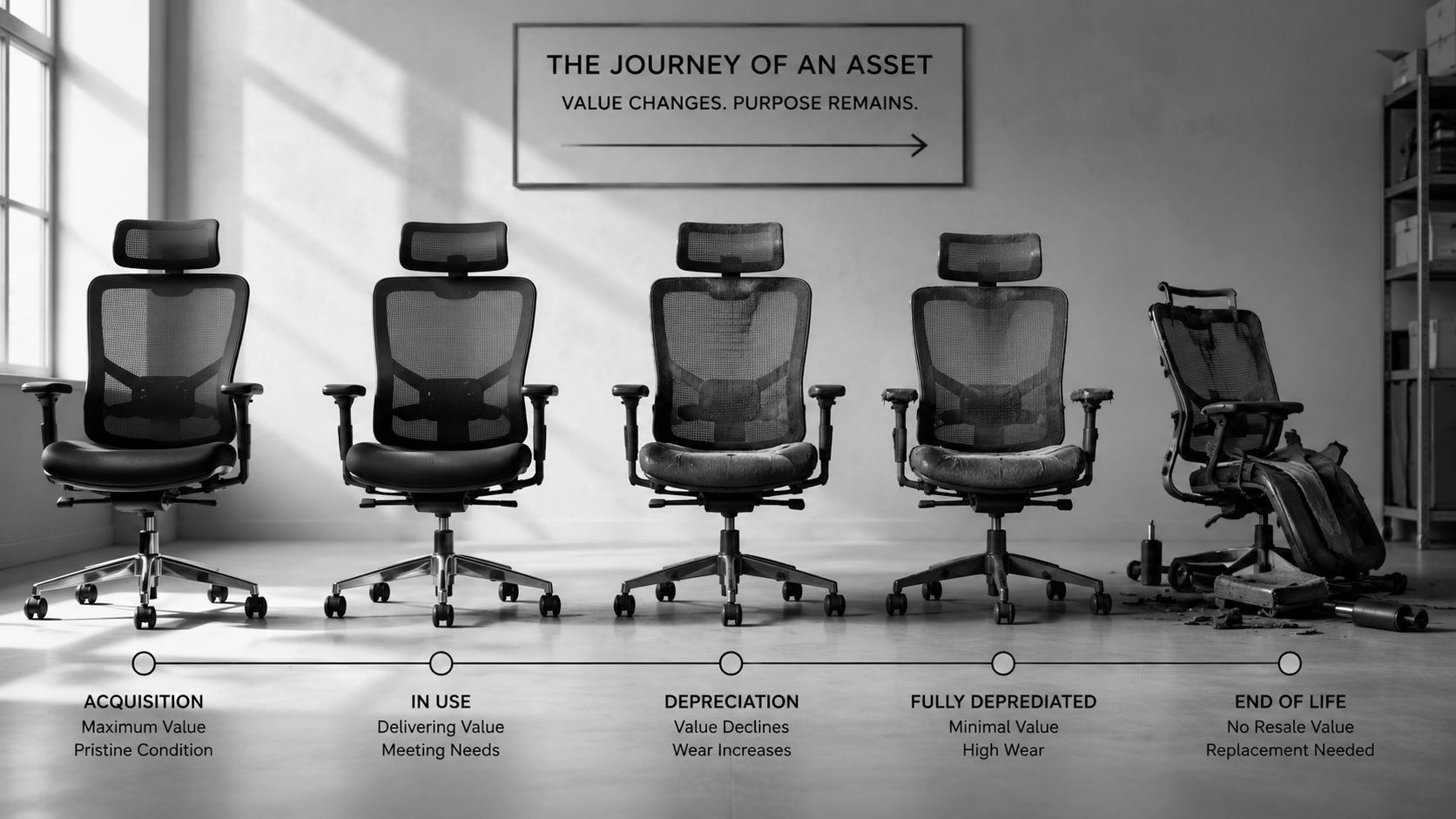
An asset has a life in the books, just like it has a life in the business. You buy it. You use it. It loses value over time. Sometimes it becomes obsolete before its accounting life says it should. Eventually it’s sold, scrapped, or written off.
Diminishing value versus straight-line
The easiest way to think about depreciation is this. Some assets lose more value early, a bit like a vehicle. Others are reported more evenly over time because that gives smoother internal numbers.
For tax, many NZ businesses default to diminishing value. For assets acquired on or after 29 March 2021, the standard diminishing value rate for general plant and equipment is 30%, while vehicles often fall under 25%, based on IRD depreciation guidance for New Zealand businesses. That approach gives faster deductions upfront, which helps cash flow.
Straight-line spreads the cost more evenly across the asset’s useful life. Some owners prefer that for internal reporting because profits don’t move around as much from year to year.
What I’d choose in practice
For most small businesses:
- Use IRD diminishing value for tax if cash flow matters and the asset class fits
- Use straight-line internally if you want steadier monthly or annual reporting
- Stay consistent once you’ve chosen the treatment
A method is only useful if it’s applied properly and kept current in the register.
Disposals matter too. If an asset is sold, scrapped, or replaced, record it properly. Leaving old assets sitting in the register creates false book values and messy depreciation.
If you want a broader view of disposal planning and record keeping for tech assets, these IT asset management strategies give a decent checklist mindset, even though the accounting treatment still needs to match NZ rules.
Using Cloud Tools and Staying Audit Ready
Most SMEs don’t need a fancy system to start. Xero’s fixed asset register is usually enough if assets are added consistently and reviewed properly. It works well for straightforward businesses with vehicles, tools, fit-outs, office equipment, and standard plant.

A more asset-focused add-on can make sense when you’ve got equipment spread across sites, maintenance schedules to track, or more moving parts in the field. In those cases, better location tracking and reminders can save time.
Software helps, but discipline wins
A good cloud system can reduce admin. A 2022 University of Auckland study found that NZ businesses using cloud-based fixed asset management tools saw a 28% reduction in time spent on annual asset reconciliation compared with manual spreadsheets, as noted in this summary of cloud accounting benefits.
But software doesn’t fix poor habits. The strongest routine is still simple:
- Review once a year at minimum
- Walk the site, don’t just review the ledger
- Check disposals, write-offs, and new purchases
- Make sure finance agreements match the recorded assets
That’s what keeps you audit ready. More than that, it keeps your numbers useful for actual decisions.
Common Questions and Your Path to Financial Clarity
What’s the biggest mistake owners make?
They stop reviewing the register. Once that happens, assets that no longer exist stay on the books, new purchases get missed, and depreciation stops matching reality.
How often should a fixed asset register be reviewed?
Quarterly is a good discipline for most growing businesses. At minimum, do a proper annual review and a physical check against what’s in the accounting file.
Should small items go into the register?
It depends on how you treat them for accounting and tax, and whether they’re worth tracking for control purposes. The key is consistency. If an item is capitalised, it needs to be recorded properly. If it’s expensed, don’t let it drift halfway into the register by accident.
What if the register is already a mess?
Start with a reset. Walk through what exists. Remove what’s gone. Add what’s missing. Recalculate depreciation from a clean base. Then tie that back to replacement planning so you’re not caught short when vehicles, plant, or fit-outs need funding.
Good fixed asset management gives you more than clean accounts. It gives you fewer surprises.
If you’re an Auckland business owner or property investor and your asset register feels out of date, unclear, or harder than it should be, Business Like NZ Ltd can help. They’re down-to-earth Chartered Accountants based in Manukau, with practical experience supporting businesses that want better cash flow visibility, less admin stress, and more confidence in the numbers. If your goal is financial freedom, more time away from the books, and cleaner decision-making, they’re the kind of affordable, straight-talking advisors worth having in your corner.