
Your Guide to Business Recovery Planning
November 3, 2025
Finding a Top Property Accountant Auckland for Your Investments
November 3, 2025
How to Calculate ROI Percentage: A Practical NZ Guide
Knowing how to calculate ROI percentage is actually pretty straightforward. You just take the net profit of an investment, divide it by how much it originally cost, and then multiply that number by 100. This simple formula cuts through the noise and tells you exactly how much bang you got for your buck.
Why Calculating ROI Is Your Business Superpower
Ever look at your business finances and wonder if all that money you’re spending is actually making a difference? It’s a common feeling for small business owners and property investors across New Zealand. We often end up relying on gut instinct when we should be looking at the cold, hard numbers.
This is where Return on Investment (ROI) comes in. It’s a simple metric, but it’s an incredibly powerful guide for making smarter financial decisions. Think of it as your business’s financial compass, always pointing you towards what’s profitable.
Moving Beyond Guesswork
At its heart, ROI answers one crucial question: for every dollar I put in, how many am I getting back? This applies to practically every dollar you spend to grow your business or investment portfolio.
- Marketing Campaigns: Did that $2,000 Google Ads spend actually bring in enough new customers to be worthwhile?
- New Equipment: Is that shiny new $15,000 piece of machinery for the workshop paying for itself through increased efficiency?
- Property Renovations: Will putting a new kitchen in that Auckland rental property really increase its value and what I can charge for rent?
When you know how to calculate ROI, you can stop guessing. You gain the confidence to put your hard-earned money where it’s going to work the hardest for you.
ROI isn’t just some fancy term for big corporations. It’s a practical, everyday tool that tells you if your money is actually working. It’s what helps you move from just hoping an investment pays off to building a strategy based on what you know works.
This guide will walk you through it all, showing you exactly how to use this essential tool to build a more secure and profitable future.
Feeling a bit lost in the numbers? At Business Like NZ Ltd, we are affordable, down-to-earth chartered accountants who love supporting Auckland businesses and property investors. We can help you make sense of your ROI and get you back in control.
The Simple ROI Percentage Formula Explained
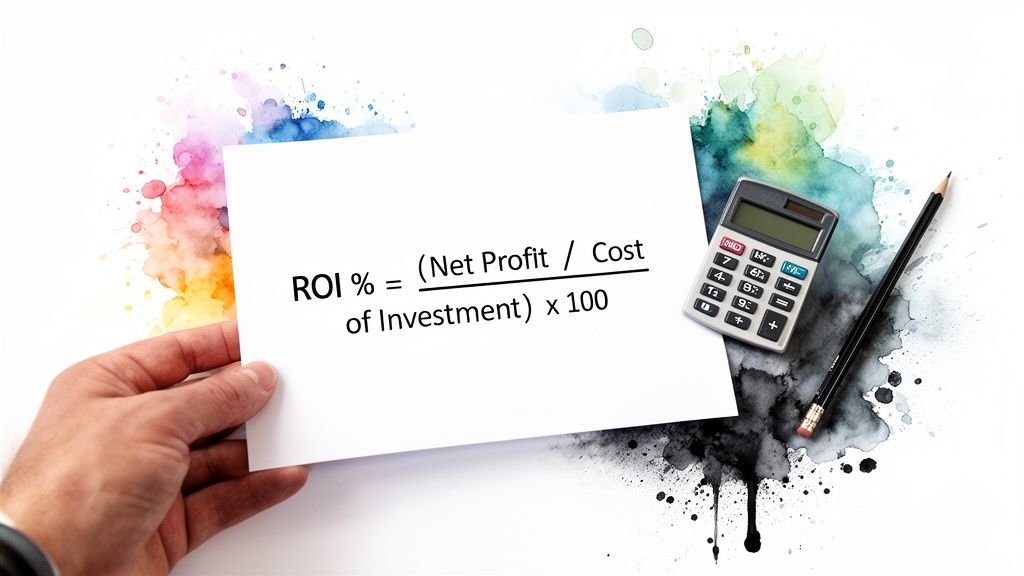
Ready to get into the numbers? I’ve found that many business owners think calculating ROI is going to be complicated, but it’s actually much simpler than it seems. You don’t need a degree in accounting to figure out if your money is working hard for you.
At its heart, the ROI formula is pretty straightforward.
ROI % = (Net Profit / Cost of Investment) x 100
Turning your return into a percentage like this is incredibly useful. It lets you compare completely different types of investments on a level playing field—whether that’s a new marketing campaign, a piece of equipment, or even hiring a new team member.
Breaking Down the ROI Formula
Before you can plug in the numbers, you need to be crystal clear on what each part of the formula actually means for your business. Getting this right is the key to an accurate calculation.
Here’s a quick look at the terms you’ll be working with.
| Term | What It Really Means | Example (For a New Coffee Machine) |
|---|---|---|
| Net Profit | This isn’t just the total sales you made. It’s the actual profit left over after you’ve subtracted all the costs tied to that investment. | The extra revenue from coffee sales, minus the cost of the extra beans, milk, and cups. |
| Cost of Investment | This is the total amount of money you had to spend to get the investment going. It’s more than just the sticker price. | The $5,000 price of the machine, plus the $500 it cost to get it professionally installed. |
When you define these terms properly, your ROI figure will reflect the real-world performance of your investment, giving you a true measure of its success. If you’re keen to dive deeper, there’s a complete guide to calculating Return on Investment that covers this in more detail.
A Practical Example In Action
Let’s put this into practice with a real-world scenario. Imagine you run a bustling café in Auckland and decide to invest in a new, top-of-the-line coffee machine. The goal is to serve customers faster and improve the quality of your coffee, hopefully bringing in more business.
Here’s a breakdown of how the numbers might look after the first year:
- Cost of Investment: The machine itself costs $5,000, and installation is another $500. Your total upfront investment is $5,500.
- Revenue Generated: You track your sales and find the new machine helped bring in an extra $12,000 over the year.
- Associated Costs: Of course, selling more coffee means using more supplies. The cost for the extra beans, milk, cups, and staff time comes to $4,000.
- Net Profit: To find your net profit, you take the extra revenue and subtract the associated costs: $12,000 – $4,000 = $8,000.
Now, we just pop those numbers into our formula.
ROI % = ($8,000 / $5,500) x 100 = 145.45%
What does this 145.45% ROI actually tell you? It means for every single dollar you put into that new coffee machine, you got that dollar back plus an extra $1.45 in profit.
Suddenly, you’re not just guessing. You have a powerful, clear number that proves the investment was a brilliant move for your café.
If tracking these kinds of figures feels overwhelming, the team at Business Like NZ Ltd is here to help. We are affordable, down-to-earth chartered accountants who specialise in supporting Auckland businesses and property investors to make sense of their numbers and find that financial clarity.
Calculating ROI for a Small Business Investment

Theory is all well and good, but the ROI formula really comes to life when you apply it to a real-world situation. Let’s walk through a practical scenario that many Kiwi business owners will recognise, so you can see exactly how the numbers play out.
Picture this: you run a small Early Childhood Education (ECE) centre in Manukau. To attract more families and stay ahead of safety standards, you decide to invest $20,000 in some fantastic new playground equipment. This isn’t just another bill to pay—it’s a deliberate investment aimed at growing your centre.
First, Nail Down Your Numbers
Before you can calculate anything, you need two key figures: the Cost of Investment and the resulting Net Profit.
The cost side is straightforward. The $20,000 you paid for the equipment and its installation is your Cost of Investment. Simple.
Now for the return. Let’s fast-forward a year. The new playground is a massive hit with local families, and your enrolments have shot up.
- New Revenue: You’ve welcomed 15 new children, each paying $300 a week. That brings in an extra $234,000 in revenue for the year.
- Associated Costs: Naturally, more children mean higher running costs. You’ve had to hire more staff and buy more supplies, which comes to $180,000 over the same year.
- Net Profit: To find your net profit from this specific investment, just subtract the new costs from the new revenue: $234,000 – $180,000 = $54,000.
With those figures sorted, you’re ready to see what your return looks like.
Putting the Formula to Work
It’s time to plug those numbers into the ROI formula we talked about earlier:
ROI % = (Net Profit / Cost of Investment) x 100
For our ECE centre in Manukau, the calculation looks like this:
($54,000 / $20,000) x 100 = 270%
That’s a pretty powerful result. It tells you that for every single dollar you spent on that playground, you got it back plus an extra $2.70 in profit, all within the first year. An outcome like that makes the initial spend feel like a no-brainer. This is exactly the kind of calculation we help our clients with every day, often using tools like Xero to keep the tracking straightforward. To learn more about what numbers you should be tracking, have a look at our guide on essential financial KPIs for small business.
An ROI of 270% gives you concrete proof that your investment paid off. It transforms a decision from a “gut feeling” that a new playground might be good for business into a data-backed fact. That kind of certainty is invaluable when you’re planning your next move.
This example really highlights how a simple ROI calculation can empower a business owner. Knowing this metric gives you the confidence to decide what’s next—whether that’s hiring another teacher, launching a new marketing campaign, or upgrading your indoor facilities.
If you’re an Auckland business owner or property investor who wants to get this level of clarity on your own investments, we’re here to help. At Business Like NZ Ltd, we’re affordable, down-to-earth chartered accountants who specialise in making your numbers make sense.
How to Calculate ROI for Auckland Property Investors

While the basic ROI formula is straightforward, applying it to a property investment in a dynamic market like Auckland needs a bit more nuance. A rental property isn’t a simple one-off purchase; you’ve got ongoing costs, steady rental income, and the big one: capital appreciation.
Getting your head around these different moving parts is crucial if you want a real picture of how your investment is performing. For property investors, this means you’re not just looking at one ROI figure, but two very different—and equally important—metrics.
Cash-on-Cash Return: Your Yearly Profit
The first number to get a handle on is your cash-on-cash return. Think of this as your immediate, real-world profit. It shows you exactly how much cash your property is generating each year compared to the actual cash you put in to get started. It’s the best way to see if your rental income is truly pulling its weight.
Let’s walk through a practical example with an Auckland rental property.
- Purchase Price & Costs: You’ve found a property for $800,000. Between your $50,000 deposit, legal fees, and some initial touch-ups, your total cash out-of-pocket is $90,000.
- Annual Rental Income: It’s tenanted at $750 per week, which brings in $39,000 over a full year.
- Annual Expenses: Your mortgage interest, rates, insurance, and maintenance costs for the year add up to $31,000.
First, find your annual cash profit (your net profit) by subtracting expenses from the income: $39,000 – $31,000 = $8,000.
Now, we can calculate the cash-on-cash return using our ROI formula, but with your upfront cash as the “Cost of Investment”:
($8,000 / $90,000) x 100 = 8.89%
That 8.89% is your annual ROI from rental income alone. This is a vital number. It tells you about your cash flow and helps ensure the property can sustain itself. Figuring out https://businesslike.co.nz/how-to-keep-your-rental-property-profitable/ is the name of the game, and this metric is your guide.
Total ROI: The Full Picture with Capital Growth
Cash-on-cash return is essential for day-to-day finances, but it ignores one of the biggest reasons people get into property: its value going up over time. This increase is your capital appreciation, and when you factor it in, you get your Total ROI.
Let’s stick with our example. After a year, the Auckland market has been kind, and your $800,000 property is now valued at $840,000. That’s a $40,000 gain in value on paper.
To calculate your Total ROI, you simply add this capital gain to your annual cash profit:
Total Gain = $8,000 (Cash Profit) + $40,000 (Capital Gain) = $48,000
Now, plug that total gain into the formula, still using your initial cash investment:
($48,000 / $90,000) x 100 = 53.33%
This 53.33% Total ROI reveals the true power of your investment over that year. While the cash flow was solid at nearly 9%, the real value came from the property’s increase in worth. For anyone diving into property, a solid grasp of what is ROI in real estate is absolutely critical.
Generally, a good rental yield in metro areas should sit above 5-7%, so our example’s cash-on-cash return is excellent. The total return, however, highlights a truly successful investment.
If you’re an Auckland property investor looking to get this kind of clarity on your own portfolio, let’s talk. Business Like NZ Ltd offers affordable, down-to-earth accounting support to help you track your numbers and make sure you’re maximising your returns.
What is a Good ROI Percentage?
Alright, you’ve crunched the numbers and have your ROI percentage staring back at you. Now what? The big question is always, “Is this actually any good?”
It’s a simple question, but the answer isn’t a one-size-fits-all number. What looks like a fantastic return for one investment could be a total flop for another.
For example, a sharp digital marketing campaign might pull in a brilliant 500% ROI – that’s a 5:1 return. But if you were investing in a long-term rental property, a steady 10% annual ROI would be considered a massive win. It’s all about perspective.
Context Is King
So, how do you judge your ROI? It really comes down to a few key things. Getting a handle on these will help you go from just calculating a number to making genuinely smart financial moves.
- Your Industry: Every sector plays by different rules. A tech startup is often hunting for explosive, triple-digit returns on its early investments. On the other hand, a well-established manufacturing business might be perfectly happy with a solid, predictable ROI from a new piece of machinery.
- The Risk Involved: This is a big one. The more risk you take on, the higher the potential reward needs to be. Parking your money in a low-risk term deposit will give you a small but very safe return. Pouring that same money into an unproven product line? That’s a huge gamble, and it needs to promise a much, much higher potential ROI to even be worth considering.
- The Type of Investment: As we’ve touched on, a quick marketing blitz and a 30-year property investment are entirely different animals. One is about generating fast cash, while the other is focused on long-term capital growth and steady income over decades.
Don’t Forget About Time
One of the most common mistakes I see people make is forgetting to factor in the timeframe. A 20% ROI might sound fantastic on the surface, but it’s almost meaningless without knowing how long it took to earn it.
Think about it: a 20% return in a single year is a phenomenal result for just about anything. But that same 20% return spread over ten years? That works out to be less than 2% per year, which is a pretty dismal figure that probably won’t even beat inflation.
Always annualise your ROI for any investment that takes longer than a year to pay off. This gives you a standard, comparable figure that tells you how effectively your money is performing each year.
Taking this simple step lets you compare completely different opportunities on a level playing field. It helps you weigh up whether your capital is better placed in a new business idea, a rental property, or even just a simple index fund. By thinking this way, you can start making strategic calls on where your money will truly deliver the best results.
Struggling to figure out what a good return looks like for your Auckland business or property portfolio? Business Like NZ Ltd provides affordable, down-to-earth advice. As chartered accountants, we can help you set realistic benchmarks and make sure your investments are on the right track.
Time to Take Control of Your Business Finances
Hopefully, this guide has shown you that figuring out your Return on Investment isn’t some complex financial puzzle reserved for corporate giants. It’s actually a straightforward and incredibly powerful tool for any business owner or investor here in NZ.
When you get comfortable with this simple metric, you can stop guessing and start making truly informed decisions. It helps you justify where your money goes and gives you a clear roadmap for growth.
Knowing your numbers is the first step to improving them. A solid grasp of ROI shows you exactly which parts of your business are pulling their weight and which ones might need another look. This kind of clarity is also the bedrock of smart day-to-day financial management. If you want to dig deeper into that, our guide on cashflow principles and management is a great place to start.
Feeling ready to get a handle on your numbers but not sure what to do next? Financial control is the key to building a business that can weather any storm and scale up successfully.
Here at Business Like NZ Ltd, we’re affordable, down-to-earth chartered accountants who love supporting Auckland businesses and property investors just like you. We cut through the jargon to give you practical advice that helps you understand your ROI and build your wealth.
Get in touch today for a chat about how we can help you find your financial freedom.
Common Questions About Calculating ROI
Once you start getting the hang of ROI, a few questions always seem to come up. Let’s dig into some of the things we often hear from Auckland business owners and property investors.
Can I Calculate ROI for Things That Aren’t Purely Financial?
You absolutely can. We often call this a ‘soft ROI’, and it’s perfect for things like staff training or improving your company culture. It’s a bit trickier to measure, sure, but you can definitely put a dollar value on the results.
Think about it this way. You can estimate the financial impact of:
- A boost in productivity: How much more is a newly trained team member able to produce?
- Better staff retention: What does it actually cost you to hire and train a replacement? Avoiding that is a direct saving.
- Fewer mistakes: How much money do you save by dodging costly errors that used to happen?
How Often Should I Be Checking My Marketing ROI?
Honestly, it depends entirely on what kind of marketing you’re doing. There’s no one-size-fits-all answer here.
If you’re playing the long game with something like Search Engine Optimisation (SEO), checking in quarterly is probably about right. But for a short, sharp advertising campaign on social media? You’ll want to calculate its ROI the moment it wraps up to see if it was worth it.
The key isn’t how often you do it, but that you do it consistently.
What Are the Biggest Mistakes People Make When Calculating ROI?
It’s easy to get the numbers wrong if you’re not careful. We see three mistakes pop up time and time again. The biggest one is forgetting to include all the costs – especially the value of your own time. That’s a real cost!
Another common pitfall is using your total revenue instead of your net profit. This will always make your return look much better than it actually is.
Finally, people often ignore the timeframe. A 20% return over one month is a fantastic result. That same 20% return over five years? Not so much. Context is everything.
Figuring out the ROI formula is a great first step, but using it to make smart decisions is where the real magic happens. If you’re ready to turn those numbers on a page into confident, growth-focused choices, Business Like NZ Ltd is here to help.
As affordable, down-to-earth chartered accountants, we love supporting Auckland businesses and property investors. Let’s have a chat about bringing some clarity to your finances. Find out more about how we work at https://businesslike.co.nz.